

Anaerobic pace reserve: Your secret conditioning weapon?
Everyone knows you want a critically beefy engine to drive group sport efficiency, however constructing it may be actually complicated. So in the event you’re fed up with feeling such as you’re about to throw up throughout your conditioning drills, you’ll want to hearken to episode 77 of the Science for Sport Podcast.
On this episode, world-renowned sport scientist Martin Buchheit reveals how one can plan conditioning periods with sniper-like precision, so you possibly can present your high quality for the complete match and, if crucial, past.
Conventional conditioning coaching might contain a take a look at of cardio or intermittent efficiency, adopted by a coaching prescription primarily based on the person athlete’s knowledge. This, my buddies, not cuts the mustard. The issue being that an athlete’s most dash pace (MSS) influences anaerobic efficiency considerably.
Buchheit advocates including what is known as the ‘anaerobic pace reserve’ to your cardio take a look at knowledge, and apparently, in response to Buchheit, coaches have been subconsciously doing this for many years already.
“It’s one thing that appears new for some folks, however it’s been within the air for some time. I believe for monitor and area coaches, [they knew about it] about 100 years in the past,” Buchheit mentioned.
Including what is known as the ‘anaerobic pace reserve’ to your cardio take a look at knowledge is usually a game-changer for some athletes.

Some essential definitions
Earlier than we get into some incredible physiology, we have to tackle board some essential definitions, which assist to border the dialogue:
Most Cardio Pace (MAS): The slowest pace an athlete will obtain their V02 max
Most Dash Pace (MSS): The utmost pace an athlete can dash
Anaerobic Pace Reserve (ASR): Reserve of pace between the MAS and MSS
To clarify this utilizing a metaphor, Buchheit tells us to think about a glass of water. If you happen to fill the glass as much as simply above half with water, you’ll have your MAS. Now add in oil, which sits on prime of the water – that’s your Anaerobic Pace Reserve. The highest of the oil can be your MSS. Fortunate he’s an ideal sports activities scientist – he’d make a horrible barman.
Placing some numbers on this, let’s say that your MAS was 18km/h, and your MSS was 30km/h.
“The quantity of oil between 18-30km/h — the quantity of oil you can put in — is the ASR,” Buchheit mentioned.
The-all essential knowledge
So how will you get knowledge to plot? Effectively, that is pretty easy – testing for max pace simply requires some timing gates and a distance between 30-60m. On this take a look at you merely run as quick as potential to get your MSS. For MAS, you possibly can simply use a 1500-2000m time trial, the place you run this distance as quick as potential too. Taking the speeds of those assessments will permit you to create a bar chart (determine 1) and begin to examine to your earlier outcomes, or to different athletes. That is the place it will get attention-grabbing.
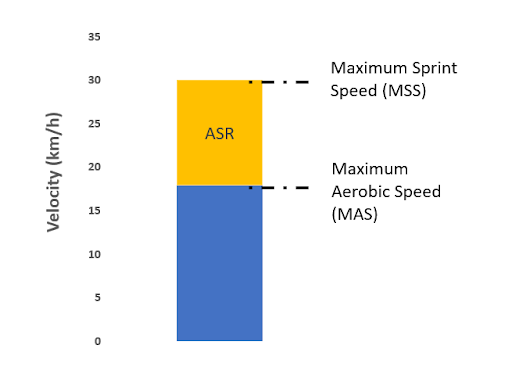
Determine 1: Bar graph exhibits methods to plot most cardio pace, most dash pace and anaerobic pace reserve.
A sensible instance
Some athletes might have the identical MAS scores, however differing MSS. Let’s take the instance of two athletes (for enjoyable, let’s name them James de Lacey, my Science for Sport colleague, and me, Matt Solomon), each with a MAS of 18km/h. James has an MSS of 30km/h, Matt of 36km/h. These athletes have an ASR of 12km/h and 18km/h respectively.
If you happen to prescribed conditioning coaching primarily based solely on their MAS scores, James must work nearer to their maximal dash pace than Matt. This causes a problem as a result of both James is working approach too exhausting, or Matt is sauntering round with no problem in any respect. By permitting for his or her ASR, coaches can optimise an athlete’s conditioning work.
Let’s take the next sensible examples:
Instance 1: Coach prescribes operating at 120% MAS. For each James and Matt, that is 21.6km/h.
Instance 2: Coach prescribes operating at 100% MAS + 20% ASR. James runs at 20.4km/h and Matt runs at 21.6km/h.
On this instance, we will see permitting for the ASR has meant James not overworks throughout their conditioning coaching.
“As an alternative of prescribing intervals primarily based solely on percentages of MAS, we will now prescribe intervals primarily based on the share of the reserve. As an alternative of doing 15s of labor of 120% MAS, we will most likely do it at 20% of the ASR. And a participant with a better reserve will do extra work than or run at a better pace than one other athlete with the identical MAS however a smaller reserve,” Buchheit mentioned.
All you’ll want to know concerning the anaerobic pace reserve
Buchheit goes on to debate how one can group athletes primarily based on their profiles, hyperlink this to muscle fibre kind, and subsequently how one can modify the conditioning work you do to the kind of athlete. It is a actually essential consideration for anybody working in group sports activities, who’ve a wide range of athlete varieties.
If you wish to hear how one can take the ASR a notch additional, hearken to the entire podcast with Buchheit utilizing the hyperlink under.
You’ll be able to obtain the podcast on any of the large internet hosting companies, together with Apple Podcasts and Spotify, or simply use this hyperlink: https://scienceforsport.fireplace.fm/77
Don’t neglect to hit the subscribe button and make sure to give us a evaluation and score too!